What Is Answer Engine Optimization?
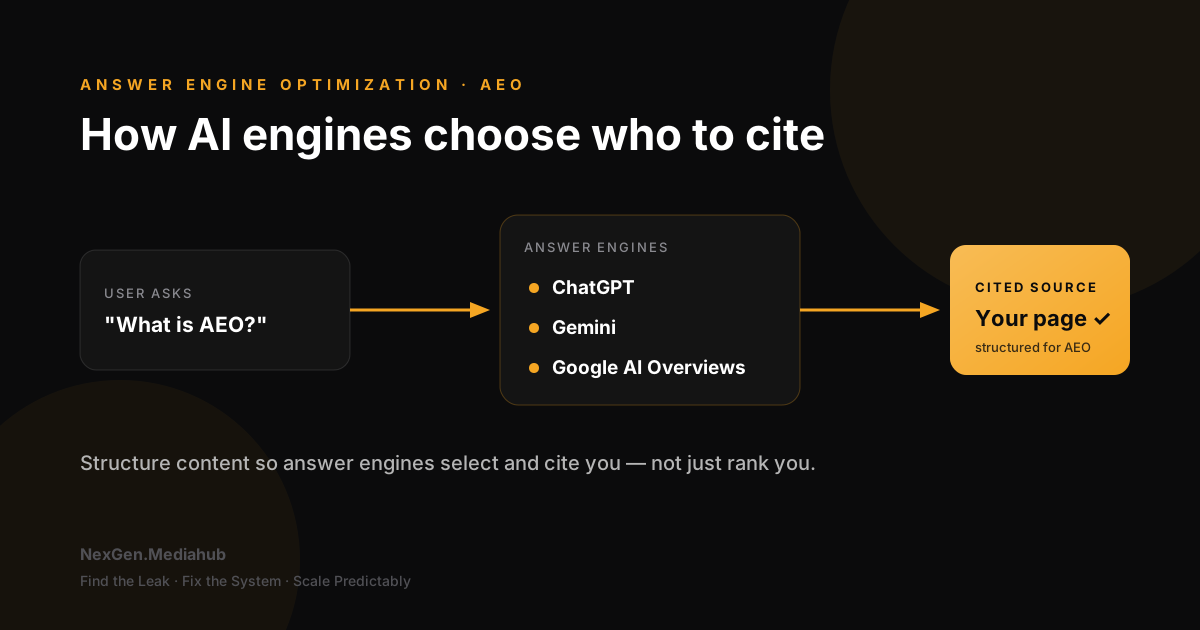
Search used to mean typing a phrase into Google and clicking through ten blue links. That’s no longer the whole picture. People now ask ChatGPT, Gemini, and Google’s AI Overviews direct questions and get a single, synthesized answer — often without visiting a website at all.
Answer Engine Optimization is the practice of structuring your content so these AI systems choose to cite you as the source of that answer. It sits next to traditional SEO, not in place of it — but it plays by different rules.
Where SEO optimizes for a ranking algorithm sorting web pages, AEO optimizes for a language model deciding which single source best answers a question, in plain language, on the spot.
Why AEO Matters Right Now, Not Eventually
This isn’t a future trend — it’s already showing measurable search demand. Global search volume for “answer engine optimization” has climbed from around 1,900 monthly searches at the start of 2026 to peaks near 2,900, with steady demand in between. That’s a category actively forming in real time, not a term coined by a marketing blog.
For Indian businesses specifically, the opportunity is wider than it looks. Very few agencies in India are building content specifically for AI-engine citation yet — most are still optimizing purely for Google’s traditional results. That gap won’t stay open long.
AEO vs SEO vs GEO: What Actually Separates Them
These three terms get used almost interchangeably, which causes confusion. Here’s the real distinction:
- SEO (Search Engine Optimization) — getting your page to rank in traditional search results, competing against other pages for position.
- AEO (Answer Engine Optimization) — getting your content selected as the answer inside an AI response, whether that’s a voice assistant, a chat interface, or a search engine’s AI summary box.
- GEO (Generative Engine Optimization) — the broader practice of shaping content so generative AI systems (not just answer boxes, but full AI-written responses) draw on and cite your material. The term traces back to academic research on generative engines.
In practice, AEO and GEO overlap heavily and are often used as synonyms in casual conversation. SEO is the older, narrower discipline both build on. AEO isn’t replacing SEO — a page still needs to rank and be crawlable before an AI engine can consider citing it. Think of AEO as an additional layer of structure on top of solid SEO fundamentals, not a replacement for them.
How AI Engines Actually Choose What to Cite
AI engines don’t “read” your website the way a person does — and Google itself now documents how content can surface in AI features like AI Overviews. They rely on a combination of signals:
Clear, direct answers near the top of the page. If someone asks “what is X,” an AI engine favors content that answers that question in the first few sentences — not content that builds up to the answer through a long narrative introduction.
Structured formatting. Headers, bullet points, and tables are easier for these systems to extract and quote accurately. Dense paragraphs without structure are harder to parse cleanly.
Schema markup. FAQ schema, Article schema, and Organization schema give AI systems machine-readable confirmation of what your content is and who’s behind it — this is a technical layer most businesses skip entirely.
Established authority signals. Consistent publishing on a topic, clear authorship, and other sites referencing your content all feed into whether an AI system treats you as a credible source worth citing.
Direct question-and-answer structure. Content written in the same question format people actually ask AI engines tends to get pulled into responses more often — which is exactly why the FAQ section below is written the way real people phrase these questions, not the way a marketer might.
An AEO Checklist You Can Actually Use
Run any page through this answer engine optimization checklist before you publish:
- Write a direct, one-to-two-sentence answer to your page’s core question within the first 100 words.
- Use H2/H3 headers that are phrased as actual questions, not just topic labels.
- Add FAQ schema to any page answering multiple related questions.
- Keep paragraphs short — three to four sentences, not seven.
- Include comparison tables where relevant (AI engines favor extractable, structured data over prose).
- Publish consistently on a topic area rather than a single one-off post.
- Make sure your Organization schema and author information are set up correctly site-wide.
How NexGen Approaches AEO for Clients
We treat answer engine optimization the same way we treat every part of a growth system — as something to build and measure, not guess at. That means auditing existing content for AI-extractability, restructuring pages around real question data (not assumed keywords), adding the schema layer most competitors skip, and tracking whether content actually starts appearing in AI-generated answers over time.
This guide itself is a working example — it’s structured the way we’d structure it for a client, answering real questions people are documented asking AI systems, not just questions we assumed mattered.
Frequently Asked Questions
Is AEO replacing SEO?
No. AEO builds on SEO fundamentals — a page still needs to be indexed, crawlable, and reasonably well-optimized before an AI engine will consider citing it. AEO adds structure and clarity on top of that foundation.
What’s the difference between AEO and SEO?
SEO focuses on ranking in traditional search results. AEO focuses on being selected as the direct answer inside an AI-generated response, whether that’s a chat interface or an AI Overview box.
How do I do AEO step by step?
Start with a clear answer near the top of the page, use question-phrased headers, add FAQ schema, keep formatting scannable, and publish consistently on your core topics rather than one-off pieces.
What tools exist for AEO?
A growing set of tools now track AI-visibility specifically — platforms built to monitor whether your content is appearing in AI-generated answers, alongside traditional SEO tools that are adding AEO-adjacent features. This space is moving quickly; worth revisiting every few months rather than picking one tool permanently today.
Not sure if your current content is structured for AI citation, or just for Google rankings? Book a free Growth Audit — we’ll show you exactly where the gap is.